

What Ultimately Transfers From One Location To Another In Electromagnetic Induction Is _________.

Alternating electric current flows through the solenoid on the left, producing a changing magnetic field. This field causes, past electromagnetic consecration, an electric current to flow in the wire loop on the right.
Electromagnetic or magnetic induction is the production of an electromotive force across an electrical conductor in a changing magnetic field.
Michael Faraday is generally credited with the discovery of induction in 1831, and James Clerk Maxwell mathematically described it as Faraday's law of induction. Lenz's constabulary describes the direction of the induced field. Faraday's law was subsequently generalized to become the Maxwell–Faraday equation, ane of the iv Maxwell equations in his theory of electromagnetism.
Electromagnetic induction has found many applications, including electrical components such as inductors and transformers, and devices such as electric motors and generators.
History

Faraday'south experiment showing induction between coils of wire: The liquid battery (right) provides a electric current that flows through the modest coil (A), creating a magnetic field. When the coils are stationary, no current is induced. But when the minor coil is moved in or out of the large coil (B), the magnetic flux through the large whorl changes, inducing a current which is detected by the galvanometer (G).[one]

A diagram of Faraday's atomic number 26 band apparatus. Change in the magnetic flux of the left coil induces a current in the right gyre.[ii]
Electromagnetic induction was discovered past Michael Faraday, published in 1831.[3] [iv] It was discovered independently past Joseph Henry in 1832.[5] [half-dozen]
In Faraday's starting time experimental demonstration (August 29, 1831), he wrapped two wires around reverse sides of an fe band or "torus" (an system similar to a modernistic toroidal transformer).[ citation needed ] Based on his understanding of electromagnets, he expected that, when current started to flow in 1 wire, a sort of moving ridge would travel through the ring and cause some electrical effect on the reverse side. He plugged i wire into a galvanometer, and watched information technology as he connected the other wire to a bombardment. He saw a transient current, which he called a "wave of electricity", when he connected the wire to the battery and another when he disconnected information technology.[7] This induction was due to the change in magnetic flux that occurred when the battery was connected and disconnected.[2] Within two months, Faraday plant several other manifestations of electromagnetic consecration. For example, he saw transient currents when he quickly slid a bar magnet in and out of a coil of wires, and he generated a steady (DC) electric current by rotating a copper disk near the bar magnet with a sliding electrical pb ("Faraday's disk").[8]
Faraday explained electromagnetic induction using a concept he called lines of force. Still, scientists at the time widely rejected his theoretical ideas, mainly because they were not formulated mathematically.[9] An exception was James Clerk Maxwell, who used Faraday's ideas every bit the basis of his quantitative electromagnetic theory.[ix] [10] [11] In Maxwell's model, the fourth dimension varying aspect of electromagnetic induction is expressed as a differential equation, which Oliver Heaviside referred to as Faraday's police even though information technology is slightly dissimilar from Faraday's original formulation and does not describe motional EMF. Heaviside's version (see Maxwell–Faraday equation below) is the form recognized today in the group of equations known every bit Maxwell'due south equations.
In 1834 Heinrich Lenz formulated the law named after him to describe the "flux through the circuit". Lenz'southward constabulary gives the management of the induced EMF and current resulting from electromagnetic induction.
Theory
Faraday'south law of induction and Lenz'due south police

The longitudinal cantankerous section of a solenoid with a constant electric current running through it. The magnetic field lines are indicated, with their direction shown by arrows. The magnetic flux corresponds to the 'density of field lines'. The magnetic flux is thus densest in the middle of the solenoid, and weakest outside of it.
Faraday'due south law of induction makes use of the magnetic flux ΦB through a region of space enclosed by a wire loop. The magnetic flux is divers by a surface integral:[12]
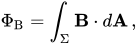
where d A is an element of the surface Σ enclosed by the wire loop, B is the magnetic field. The dot product B·d A corresponds to an infinitesimal amount of magnetic flux. In more visual terms, the magnetic flux through the wire loop is proportional to the number of magnetic field lines that pass through the loop.
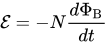
When the flux through the surface changes, Faraday'southward police of induction says that the wire loop acquires an electromotive force (EMF).[note 1] The nearly widespread version of this law states that the induced electromotive strength in whatever closed circuit is equal to the rate of change of the magnetic flux enclosed by the circuit:[xvi] [17]

where is the EMF and ΦB is the magnetic flux. The direction of the electromotive force is given by Lenz'due south law which states that an induced electric current will flow in the direction that will oppose the alter which produced it.[eighteen] This is due to the negative sign in the previous equation. To increase the generated EMF, a common approach is to exploit flux linkage past creating a tightly wound coil of wire, composed of N identical turns, each with the same magnetic flux going through them. The resulting EMF is then N times that of one single wire.[19] [20]

Generating an EMF through a variation of the magnetic flux through the surface of a wire loop can be accomplished in several means:
- the magnetic field B changes (east.thousand. an alternating magnetic field, or moving a wire loop towards a bar magnet where the B field is stronger),
- the wire loop is plain-featured and the surface Σ changes,
- the orientation of the surface d A changes (east.1000. spinning a wire loop into a fixed magnetic field),
- any combination of the above
Maxwell–Faraday equation
In full general, the relation between the EMF in a wire loop encircling a surface Σ, and the electric field Due east in the wire is given past
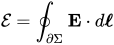
where d ℓ is an chemical element of contour of the surface Σ, combining this with the definition of flux
we can write the integral form of the Maxwell–Faraday equation
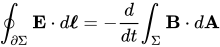
It is one of the iv Maxwell's equations, and therefore plays a fundamental role in the theory of classical electromagnetism.
Faraday'south law and relativity
Faraday's law describes two different phenomena: the motional EMF generated by a magnetic force on a moving wire (see Lorentz forcefulness), and the transformer EMF this is generated by an electric force due to a changing magnetic field (due to the differential form of the Maxwell–Faraday equation). James Clerk Maxwell drew attention to the separate concrete phenomena in 1861.[21] [22] This is believed to be a unique example in physics of where such a cardinal law is invoked to explain two such unlike phenomena.[23]
Albert Einstein noticed that the ii situations both corresponded to a relative movement between a conductor and a magnet, and the outcome was unaffected by which 1 was moving. This was one of the principal paths that led him to develop special relativity.[24]
Applications
The principles of electromagnetic consecration are applied in many devices and systems, including:
- Current clamp
- Electric generators
- Electromagnetic forming
- Graphics tablet
- Hall effect meters
- Induction cooking
- Induction motors
- Consecration sealing
- Consecration welding
- Inductive charging
- Inductors
- Magnetic menses meters
- Mechanically powered flashlight
- Near-field communications
- Pickups
- Rowland band
- Transcranial magnetic stimulation
- Transformers
- Wireless energy transfer
Electric generator

Rectangular wire loop rotating at athwart velocity ω in radially outward pointing magnetic field B of stock-still magnitude. The circuit is completed by brushes making sliding contact with top and bottom discs, which accept conducting rims. This is a simplified version of the drum generator.
The EMF generated past Faraday's law of induction due to relative motility of a circuit and a magnetic field is the phenomenon underlying electrical generators. When a permanent magnet is moved relative to a usher, or vice versa, an electromotive forcefulness is created. If the wire is continued through an electrical load, electric current volition flow, and thus electrical free energy is generated, converting the mechanical energy of motion to electrical energy. For example, the drum generator is based upon the effigy to the lesser-right. A different implementation of this idea is the Faraday's disc, shown in simplified grade on the right.
In the Faraday's disc example, the disc is rotated in a uniform magnetic field perpendicular to the disc, causing a current to flow in the radial arm due to the Lorentz force. Mechanical work is necessary to bulldoze this electric current. When the generated current flows through the conducting rim, a magnetic field is generated by this electric current through Ampère'southward circuital law (labelled "induced B" in the figure). The rim thus becomes an electromagnet that resists rotation of the disc (an example of Lenz's law). On the far side of the figure, the render current flows from the rotating arm through the far side of the rim to the lesser brush. The B-field induced by this render electric current opposes the applied B-field, tending to decrease the flux through that side of the excursion, opposing the increase in flux due to rotation. On the most side of the effigy, the return electric current flows from the rotating arm through the nigh side of the rim to the lesser brush. The induced B-field increases the flux on this side of the circuit, opposing the decrease in flux due to r the rotation. The energy required to go on the disc moving, despite this reactive force, is exactly equal to the electrical energy generated (plus free energy wasted due to friction, Joule heating, and other inefficiencies). This beliefs is mutual to all generators converting mechanical energy to electrical energy.
Electrical transformer
When the electric electric current in a loop of wire changes, the changing electric current creates a changing magnetic field. A second wire in reach of this magnetic field will experience this change in magnetic field as a change in its coupled magnetic flux, d ΦB / d t. Therefore, an electromotive strength is gear up in the second loop chosen the induced EMF or transformer EMF. If the two ends of this loop are connected through an electrical load, current will flow.
Current clamp

A current clamp is a blazon of transformer with a split up core which can be spread apart and clipped onto a wire or whorl to either measure the electric current in it or, in contrary, to induce a voltage. Unlike conventional instruments the clench does not make electrical contact with the conductor or crave it to exist asunder during zipper of the clench.
Magnetic catamenia meter
Faraday's law is used for measuring the flow of electrically conductive liquids and slurries. Such instruments are chosen magnetic flow meters. The induced voltage ε generated in the magnetic field B due to a conductive liquid moving at velocity v is thus given by:

where ℓ is the distance between electrodes in the magnetic flow meter.
Eddy currents
Electrical conductors moving through a steady magnetic field, or stationary conductors within a changing magnetic field, will have round currents induced inside them by induction, called boil currents. Eddy currents flow in closed loops in planes perpendicular to the magnetic field. They have useful applications in boil current brakes and induction heating systems. However eddy currents induced in the metal magnetic cores of transformers and AC motors and generators are undesirable since they dissipate free energy (chosen cadre losses) as heat in the resistance of the metallic. Cores for these devices use a number of methods to reduce eddy currents:
- Cores of low frequency alternating current electromagnets and transformers, instead of being solid metal, are often fabricated of stacks of metallic sheets, chosen laminations, separated past nonconductive coatings. These thin plates reduce the undesirable parasitic eddy currents, as described below.
- Inductors and transformers used at higher frequencies frequently have magnetic cores made of nonconductive magnetic materials such as ferrite or iron powder held together with a resin binder.
Electromagnet laminations

Eddy currents occur when a solid metallic mass is rotated in a magnetic field, because the outer portion of the metal cuts more than magnetic lines of strength than the inner portion; hence the induced electromotive forcefulness is not uniform; this tends to crusade electric currents between the points of greatest and least potential. Eddy currents consume a considerable amount of energy and often crusade a harmful rise in temperature.[25]
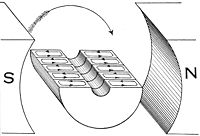
Only five laminations or plates are shown in this example, and so as to show the subdivision of the eddy currents. In practical use, the number of laminations or punchings ranges from twoscore to 66 per inch (xvi to 26 per centimetre), and brings the eddy electric current loss downwardly to about one pct. While the plates tin exist separated past insulation, the voltage is so low that the natural rust/oxide blanket of the plates is plenty to prevent current flow across the laminations.[25]

This is a rotor approximately 20 mm in diameter from a DC motor used in a CD player. Note the laminations of the electromagnet pole pieces, used to limit parasitic inductive losses.
Parasitic induction within conductors
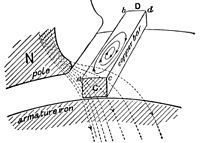
In this illustration, a solid copper bar conductor on a rotating armature is just passing under the tip of the pole piece North of the field magnet. Note the uneven distribution of the lines of force beyond the copper bar. The magnetic field is more concentrated and thus stronger on the left edge of the copper bar (a,b) while the field is weaker on the correct border (c,d). Since the two edges of the bar movement with the same velocity, this difference in field forcefulness across the bar creates whorls or current eddies within the copper bar.[25]
High current ability-frequency devices, such as electric motors, generators and transformers, utilize multiple pocket-size conductors in parallel to break upward the eddy flows that can grade within large solid conductors. The same principle is applied to transformers used at higher than power frequency, for example, those used in switch-fashion power supplies and the intermediate frequency coupling transformers of radio receivers.
See as well
- Alternator
- Crosstalk
- Faraday paradox
- Inductance
- Moving magnet and conductor problem
References
Notes
- ^ The EMF is the voltage that would be measured by cutting the wire to create an open circuit, and attaching a voltmeter to the leads. Mathematically, is defined as the free energy available from a unit of measurement charge that has traveled once around the wire loop.[13] [xiv] [15]
References
- ^ Poyser, A. Due west. (1892). Magnetism and Electricity: A Manual for Students in Avant-garde Classes. London and New York: Longmans, Green, & Co. p. 285.
- ^ a b Giancoli, Douglas C. (1998). Physics: Principles with Applications (Fifth ed.). pp. 623–624.
- ^ Ulaby, Fawwaz (2007). Fundamentals of applied electromagnetics (5th ed.). Pearson:Prentice Hall. p. 255. ISBN978-0-13-241326-8.
- ^ "Joseph Henry". Distinguished Members Gallery, National University of Sciences. Archived from the original on 2013-12-13. Retrieved 2006-eleven-30 .
- ^ Errede, Steven (2007). "A Brief History of The Development of Classical Electrodynamics" (PDF).
- ^ "Electromagnetism". Smithsonian Institution Archives.
- ^ Michael Faraday, past L. Pearce Williams, p. 182–3
- ^ Michael Faraday, by L. Pearce Williams, p. 191–five
- ^ a b Michael Faraday, by 50. Pearce Williams, p. 510
- ^ Maxwell, James Clerk (1904), A Treatise on Electricity and Magnetism, Vol. II, Tertiary Edition. Oxford Academy Press, pp. 178–ix and 189.
- ^ "Archives Biographies: Michael Faraday", The Establishment of Engineering and Technology.
- ^ Skilful, R. H. (1999). Classical Electromagnetism. Saunders College Publishing. p. 107. ISBN0-03-022353-9.
- ^ Feynman, R. P.; Leighton, R. B.; Sands, M. L. (2006). The Feynman Lectures on Physics, Volume two. Pearson/Addison-Wesley. p. 17-2. ISBN0-8053-9049-ix.
- ^ Griffiths, D. J. (1999). Introduction to Electrodynamics (third ed.). Prentice Hall. pp. 301–303. ISBN0-13-805326-10.
- ^ Tipler, P. A.; Mosca, G. (2003). Physics for Scientists and Engineers (fifth ed.). Due west.H. Freeman. p. 795. ISBN978-0716708100.
- ^ Jordan, E.; Balmain, K. M. (1968). Electromagnetic Waves and Radiating Systems (2d ed.). Prentice-Hall. p. 100.
- ^ Hayt, W. (1989). Technology Electromagnetics (5th ed.). McGraw-Hill. p. 312. ISBN0-07-027406-one.
- ^ Schmitt, R. (2002). Electromagnetics Explained . Newnes. p. 75. ISBN9780750674034.
- ^ Whelan, P. M.; Hodgeson, M. J. (1978). Essential Principles of Physics (2nd ed.). John Murray. ISBN0-7195-3382-i.
- ^ Nave, C. R. "Faraday's Law". HyperPhysics. Georgia State University. Retrieved 2011-08-29 .
- ^ Maxwell, J. C. (1861). "On physical lines of force". Philosophical Magazine. 90: xi–23. doi:10.1080/14786446108643033.
- ^ Griffiths, D. J. (1999). Introduction to Electrodynamics (tertiary ed.). Prentice Hall. pp. 301–303. ISBN0-13-805326-X. Notation that the law relating flux to EMF, which this article calls "Faraday's police force", is referred to past Griffiths every bit the "universal flux rule". He uses the term "Faraday'southward police force" to refer to what this article calls the "Maxwell–Faraday equation".
- ^ "The flux rule" is the terminology that Feynman uses to refer to the law relating magnetic flux to EMF. Feynman, R. P.; Leighton, R. B.; Sands, M. L. (2006). The Feynman Lectures on Physics, Volume II. Pearson/Addison-Wesley. p. 17-ii. ISBN0-8053-9049-9.
- ^ Einstein, A. (1905). "Zur Elektrodynamik bewegter Körper" (PDF). Annalen der Physik. 17 (10): 891–921. Bibcode:1905AnP...322..891E. doi:10.1002/andp.19053221004.
- Translated in Einstein, A. (1923). "On the Electrodynamics of Moving Bodies" (PDF). The Principle of Relativity. Jeffery, Chiliad.B.; Perret, W. (transl.). London: Methuen and Company.
- ^ a b c Images and reference text are from the public domain book: Hawkins Electric Guide, Book 1, Affiliate nineteen: Theory of the Armature, pp. 270–273, Copyright 1917 by Theo. Audel & Co., Printed in the Usa
Farther reading
- Maxwell, James Clerk (1881), A treatise on electricity and magnetism, Vol. II, Affiliate Three, §530, p. 178. Oxford, United kingdom: Clarendon Printing. ISBN 0-486-60637-6.
External links
-
 Media related to Electromagnetic induction at Wikimedia Eatables
 - Tankersley and Mosca: Introducing Faraday's law
- A complimentary java simulation on motional EMF

What Ultimately Transfers From One Location To Another In Electromagnetic Induction Is _________.,
Source: https://en.wikipedia.org/wiki/Electromagnetic_induction
Posted by: harristhild1970.blogspot.com
0 Response to "What Ultimately Transfers From One Location To Another In Electromagnetic Induction Is _________."
Post a Comment